


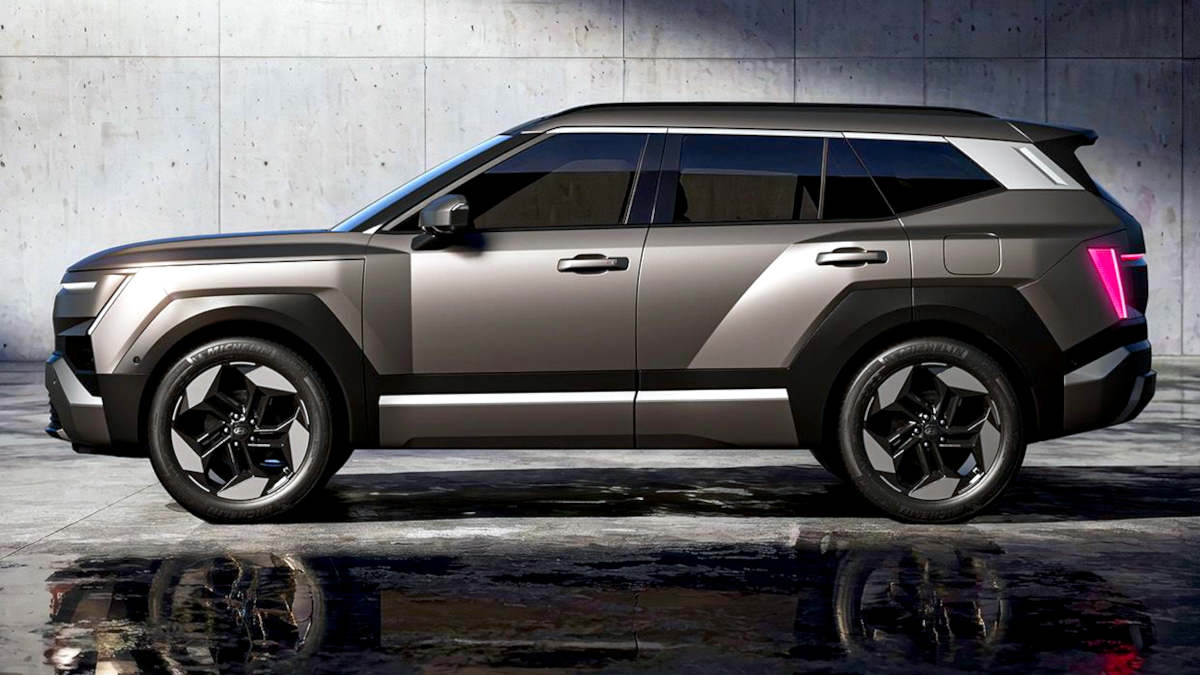
Hyundai Motor Company has officially revealed the fifth-generation 2027 Hyundai Tucson in South Korea, marking the popular compact crossover's first complete ground-up redesign in six years. Moving away from the sharp parametric jewel surfaces of its predecessor, the redesigned SUV introduces Hyundai's chiseled Art of Steel design philosophy, a substantially larger cabin, and an upgraded 245-horsepower hybrid powertrain.
Following an initial design preview, Hyundai hosted the vehicle's formal media presentation at the CJ ENM Studio Center in Paju, confirming extensive mechanical and technological upgrades. With sales scheduled to open in October, the new Tucson redefines expectations in the global compact SUV category by stretching its dimensions closer to midsize territory while debuting the company's new Pleos Connect digital ecosystem.
What Is New for the 2027 Hyundai Tucson?
The fifth-generation Tucson represents a radical structural and visual evolution. The exterior sheds complex body creases in favor of taut sheet metal surfaces and solid proportions inspired by architectural structures, a styling direction Hyundai calls Art of Steel.
Under the skin, the platform has grown in every crucial dimension. The new model is 60 mm longer, 40 mm wider, and sits on a 30 mm longer wheelbase than the fourth-generation crossover, noticeably unlocking more passenger room. Aerodynamic efficiency has also improved, with the drag coefficient dropping from 0.33 to 0.30 Cd thanks to active air flaps, an optimized rear spoiler, and aerodynamic underbody shaping.
Mechanical changes are equally substantial. The standard 1.6-liter turbocharged gasoline model replaces its older seven-speed dual-clutch transmission with a smoother eight-speed torque-converter automatic, while the 1.6-liter turbo hybrid system receives a power bump to 245 metric horsepower alongside improved fuel economy.
Key Features: Design, Cabin Tech, and Outdoor XRT Grade
The front fascia of the 2027 Tucson features vertical H-Edge daytime running lights paired with a slim horizontal center lamp that uses indirect illumination to conceal the light source when turned off. Around back, the SUV gains three-dimensional prism taillamps with intricate geometric lens patterns, while the rear license plate has been relocated downward into the sculpted rear bumper.
For adventure-minded drivers, Hyundai confirmed an outdoor-themed XRT model from rollout. The Tucson XRT adds rugged aesthetic hardware, including a dark-finish front grille, bold skid plates, and protective wheel arch garnishes.
Inside, the cabin takes a functional, driver-focused leap forward:
- Floating Dashboard Architecture: A multi-tiered dashboard separated by continuous air vents creates a clean, open atmosphere, anchored by a double D-cut multifunction steering wheel.
- Display Choices: The cockpit offers widescreen center touchscreens in 16:9 aspect ratio formats, measuring up to 17 inches (with a 12.9-inch configuration on select models), complemented by dedicated physical controls for primary climate and media adjustments.
- Pleos Connect Software: The new Tucson is the first Hyundai SUV equipped with Pleos Connect, featuring an integrated app market for in-car video streaming, audio, and gaming, along with Gleo AI voice assistance.
- Everyday Storage Innovations: The center console incorporates a palmrest hidden storage tray, Hyundai AddGear modular clip-in accessories, and an available dual wireless smartphone charging deck.
- Enhanced Ingress and Safety: Second-row doors now swing open to 83 degrees (up from 73 degrees) for effortless child-seat loading, while a redundant dual-circuit door unlock power system ensures doors can unlock even during serious electrical failures.
Confirmed Technical Specifications
Hyundai has confirmed core specifications for both domestic powertrain configurations:
- 1.6 Turbo Gasoline Powertrain: 1.6-liter turbocharged four-cylinder engine producing 193 PS (approx. 190 hp) and 27.0 kgf-m (265 Nm) of torque; paired with an 8-speed automatic transmission.
- 1.6 Turbo Gasoline Fuel Economy: 12.2 km/L (approx. 28.7 mpg US) combined on front-wheel drive models with 17-inch wheels.
- 1.6 Turbo Hybrid Powertrain: Next-generation parallel hybrid system producing a combined 245 PS (approx. 241 hp) and 38.7 kgf-m (380 Nm) of torque; features e-Motion Drive handling software and predictive navigation-based Coasting Guide.
- 1.6 Turbo Hybrid Fuel Economy: 17.4 km/L (approx. 41 mpg US) combined on front-wheel drive models with 17-inch wheels, up from 16.2 km/L on the predecessor.
- Exterior Dimensions: Length: 4,700 mm; Width: 1,905 mm; Height: 1,685 mm; Wheelbase: 2,785 mm.
- Interior Packaging: Second-row headroom expanded by 29 mm to a generous 1,031 mm.
- Chassis and Ride Hardware: Upgraded N3 platform featuring reinforced front and rear suspension mounts, newly tuned damper valving, hydraulic engine mounts, and dual-stopper transmission mounts for reduced low-speed vibration.
Price and Variants
Hyundai will offer the 2027 Tucson in two core mechanical lines: 1.6 Turbo Gasoline and 1.6 Turbo Hybrid, with both available in standard and adventure-oriented XRT trim levels. Buyers will have eight exterior paint choices, including five brand-new colors such as Driftwood Gray Matte, Redrock Orange Matte, and Goyo Copper Pearl.
Official pricing will be announced in October 2026 when order banks open in South Korea. For perspective, the outgoing fourth-generation model was listed from 28.44 million won (roughly $21,300 USD) for the gasoline trim and 33.18 million won (roughly $24,800 USD) for the hybrid.
Launch and Market Availability
Commercial sales and deliveries across South Korea begin in October 2026 following the complete price announcement. Global markets, including North America, Europe, and Australasia, are expected to receive the redesigned model during the 2027 calendar year as a 2027 or 2028 model-year vehicle.
Why It Matters for Buyers
The compact SUV segment is notoriously competitive, and Hyundai's decision to add substantial length and width directly solves common family gripes. The 83-degree rear door opening angle and extra 29 mm of rear headroom will make day-to-day usability far friendlier for growing families.
On the road, the decision to drop the dual-clutch transmission in favor of a conventional 8-speed automatic addresses long-standing complaints regarding low-speed hesitation in heavy traffic. Meanwhile, a 1.2 km/L jump in hybrid fuel economy alongside 245 metric horsepower ensures buyers do not have to trade performance to achieve low running costs.
What Remains Unknown
Detailed trim-by-trim retail pricing remains under wraps until October. Furthermore, Hyundai has not yet detailed exact boot cargo volumes behind the second row or disclosed region-specific powertrain plans, such as whether a plug-in hybrid (PHEV) variant will accompany the standard hybrid in European and American showrooms.
AkulRide Verdict
The fifth-generation 2027 Hyundai Tucson represents an intelligent and calculated evolution. By adopting cleaner architectural proportions, enlarging the passenger space, fixing low-speed transmission drivability, and giving the hybrid extra muscle without hurting efficiency, Hyundai has built a formidable all-rounder. If showroom pricing remains disciplined when numbers drop next month, the new Tucson is primed to remain a dominant force in family transportation worldwide.
User Discussion