


The internal combustion engine isn't the only thing being disrupted today. In 2026, the real battle is raging under the floorboards of your next electric vehicle. The era of the single, one-size-fits-all lithium-ion battery is officially dead.
Automakers are now splintering their lineups with radically different battery chemistries, each tailored to specific drivers. Whether you are hunting for an ultra-cheap city commuter, a million-mile workhorse, or a premium cruiser that charges in five minutes, the battery dictates the entire ownership experience.
At Akul Ride, we are breaking down the 2026 battery revolution. Let's compare the three heavyweights fighting for EV dominance: Lithium Iron Phosphate (LFP), Sodium-Ion, and the elusive Solid-State battery.
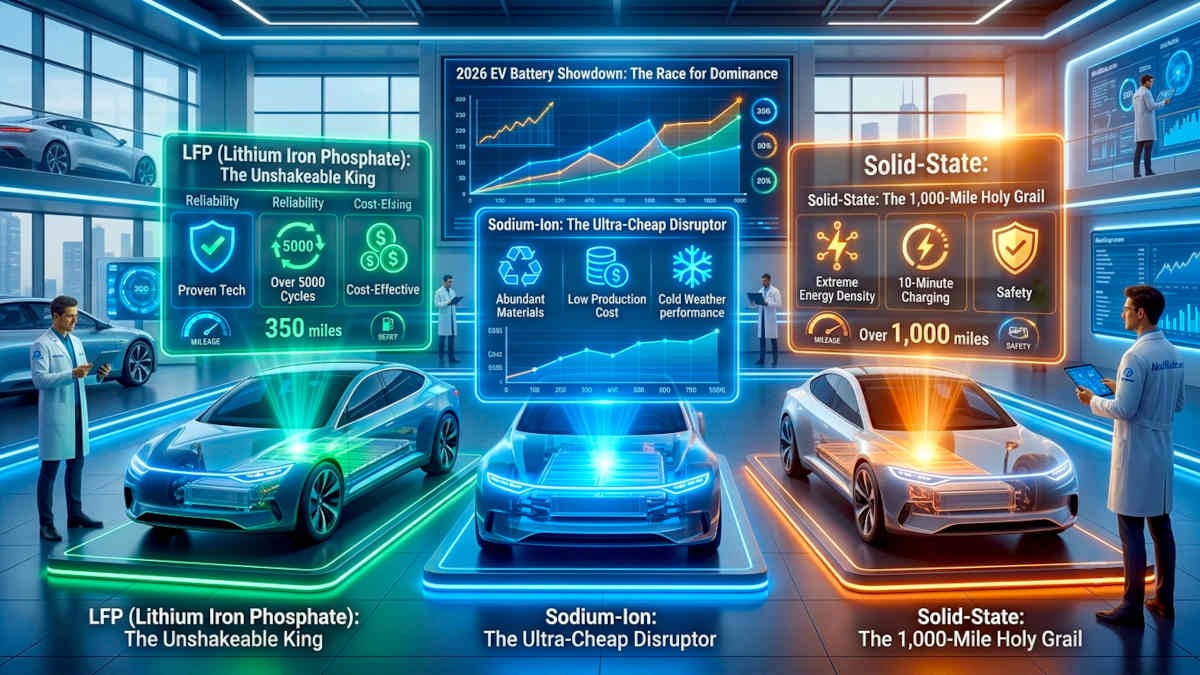
LFP (Lithium Iron Phosphate): The Unshakeable King
If you are buying a mainstream EV in 2026, there is a massive chance it is powered by an LFP pack. Lithium Iron Phosphate has shed its outdated reputation as a "budget only" option to become the bankable, undisputed king of the auto industry.
Why LFP Dominates Today
LFP batteries ditch controversial and expensive materials like nickel and cobalt in favor of abundant iron and phosphate. This makes them incredibly safe and virtually immune to the thermal runaway fires associated with older chemistries.
- Unmatched Lifespan: Modern LFP packs, like BYD's latest Blade iterations, frequently boast over 5,000 charge cycles. That equates to an EV battery that outlives the chassis.
- Charge to 100%: Unlike traditional lithium-ion packs that suffer when pushed past an 80% limit, LFP thrives when charged to 100% daily.
- Cost-Effective: Massive economies of scale have made LFP the most cost-effective way to achieve 250 to 350 miles of real-world range.
For the average consumer in 2026, LFP remains the safest, most reliable, and well-supported choice on the dealership lot.
Sodium-Ion: The Ultra-Cheap Disruptor
If LFP is the reigning king, Sodium-Ion is the rebellious upstart. Instead of using lithium, these batteries utilize sodium—one of the most abundant and inexpensive elements on Earth. In 2026, this technology has officially moved from the laboratory to mass-produced urban vehicles.
The Sodium Advantage
Sodium-ion production costs are estimated to be roughly 30% lower than LFP. This massive cost reduction is the catalyst automakers desperately need to finally deliver sub-$20,000 EVs to the masses.
- No Supply Chain Drama: Zero lithium, zero cobalt, and zero copper mean automakers are free from highly volatile mining markets.
- Cold Weather Warrior: Sodium-ion retains excellent power delivery and accepts charging even at -20°C, heavily outperforming traditional lithium packs in freezing winter states.
- Safe and Stable: Like LFP, sodium-ion packs are incredibly thermally stable and can even be shipped safely at a 0% charge state.
The catch? Energy density. While CATL's new Naxtra cells hit an impressive 175 Wh/kg, they still lag behind LFP's peak output. For now, expect Sodium-Ion to dominate entry-level city EVs, scooters, and home energy storage rather than long-haul highway cruisers.
Solid-State: The 1,000-Mile Holy Grail
Solid-state batteries are the science-fiction dream finally bleeding into reality. By replacing the flammable liquid electrolyte with a solid conductive material—such as ceramics or sulfides—these batteries unlock staggering performance metrics.
Where Solid-State Stands in 2026
While semi-solid batteries are already heavily utilized in high-end industrial drones and a few premium Chinese EVs, true all-solid-state batteries for mass-market cars are currently deep into pilot production and prototype validation. Legacy giants like Toyota are eyeing a broader commercial rollout around 2027 and 2028.
- Massive Range: Targeting 400 to 500 Wh/kg, commercial solid-state packs can easily push EV ranges past the 600-mile mark without increasing vehicle weight.
- Lightning Fast Charging: Without the risk of boiling liquid electrolytes, these batteries can accept massive fast-charging speeds—potentially giving you an 80% charge in the time it takes to pump gas.
- Ultimate Safety: The solid architecture drastically raises the thermal threshold to around 247°C, making battery fires virtually a thing of the past.
When they fully arrive, expect solid-state batteries to debut exclusively in luxury flagships and supercars due to high initial manufacturing complexities.
The Verdict: Which Battery Wins Your Garage?
The 2026 battery revolution isn't a winner-take-all deathmatch. Instead, it is a massive win for the consumer because of perfect specialization. The "best" battery now depends entirely on how you drive.
- Buy LFP if: You want a proven, ultra-reliable daily driver with a massive lifespan and no charging anxiety. It is the definitive all-rounder today.
- Look for Sodium-Ion if: You are shopping for an affordable second car, a city commuter, or live in a freezing climate where you need cheap, consistent winter performance.
- Wait for Solid-State if: You are a road-warrior holding out for extreme range and gas-station-equivalent fill-up times—and you don't mind paying early-adopter premiums.
The EV market has never been more exciting or more varied. Keep it locked to Akul Ride as we continue testing these revolutionary packs in the real world.
User Discussion