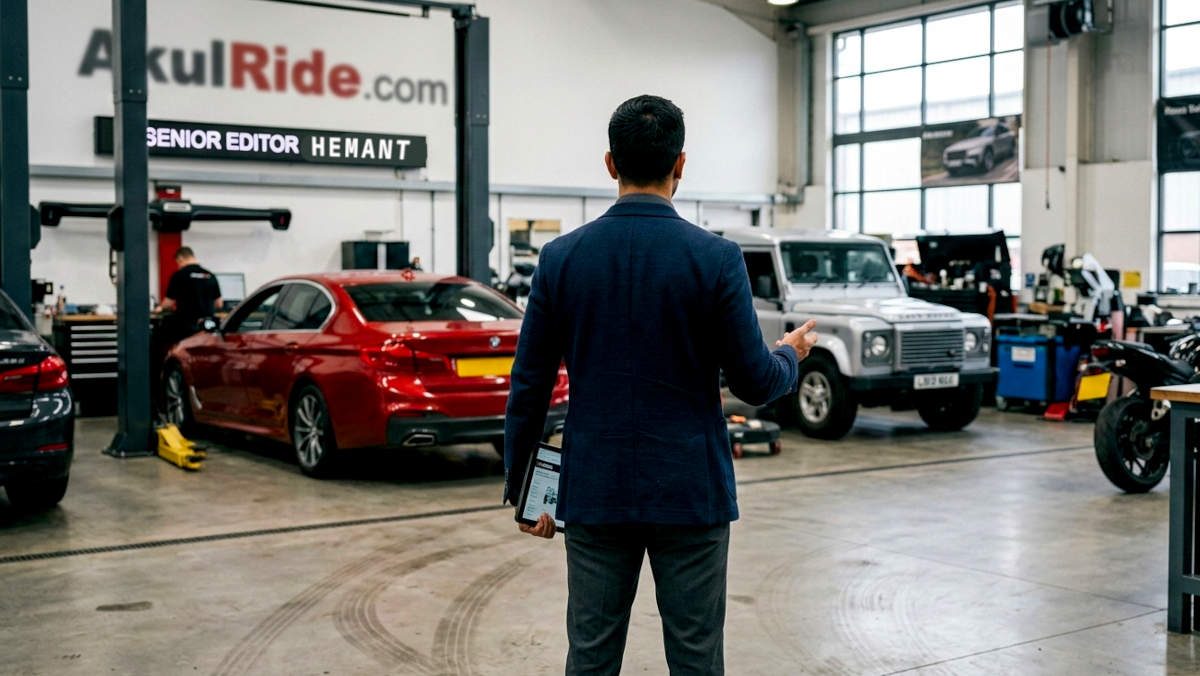


Thousands of Indian car owners who paid substantial showroom premiums for lightning-fast dual-clutch automatic gearboxes are facing daily frustration as dry-clutch DCTs and DSGs struggle with the punishing crawl of metro traffic. Trapped in the bumper-to-bumper gridlock of Bengaluru, Mumbai, and Delhi-NCR in searing 42-degree summer heat, drivers are routinely greeted by jerky low-speed judders and flashing transmission overheating warnings on their digital instrument clusters.
At a Glance: The Transmission Reality
- The Core Engineering Conflict: Dry dual-clutch transmissions (DCT/DSG) rely exclusively on ambient air for clutch cooling, leaving friction plates vulnerable to extreme thermal buildup during prolonged low-speed slipping.
- The Peak Traffic Symptom: Stop-and-go creeping between 5 km/h and 15 km/h forces continuous half-clutch slippage, leading to cabin shudder, hesitations off the line, and protective ECU limp-mode shutdowns.
- Long-Term Financial Risk: Out-of-warranty mechatronic control unit and dual-clutch pack replacements routinely cost between ₹1.2 Lakh and ₹2.5 Lakh, severely depressing five-year vehicle resale value.
- Primary Transmission Benchmarks: Dry DCT (Hyundai/Kia 7-speed, VW/Skoda 7-speed DQ200) vs Wet-clutch DCA (Tata 6-speed) vs Torque Converters (Aisin 6-speed, Hyundai 6-speed) vs e-CVTs (Toyota/Maruti Hybrid).
What Has Changed?
During test drives on smooth ring roads and open bypasses, dual-clutch gearboxes feel unbeatable. Seamless, millisecond gear changes provide an engaging, direct connection to turbocharged petrol engines that traditional automatics historically could not replicate.
Urban traffic patterns have turned viciously hostile over the past decade. Average speeds along prime commuting corridors like Bengaluru’s Outer Ring Road or Mumbai’s Western Express Highway have dropped to single digits, transforming the daily commute into hours of non-stop crawling on the brake pedal.
Automakers have attempted to mitigate the issue through revised transmission control software and wet-clutch engineering. Tata Motors introduced its wet-clutch DCA setup to submerge friction surfaces in protective oil, while Hyundai, Kia, and the Volkswagen Group rolled out revised crawl calibrations for their dry units. Despite these software patches, the fundamental laws of dry friction remain unyielding under sustained thermal stress.
Specifications & Thermal Physics
Understanding why dry DCTs shudder in slow traffic requires looking at clutch engagement physics. A manual car driver instinctively knows that slipping the clutch at 8 km/h for forty-five minutes straight will destroy the friction plate. A dual-clutch transmission relies on automated electro-mechanical or hydraulic actuators to operate two separate clutches—one for odd gears and one for even gears.
When a driver inches forward in slow-moving traffic by modulating only the brake pedal, the computerized transmission slips first or second gear continuously to prevent the engine from stalling. In a dry setup, that friction heat has nowhere to escape except into ambient air. Under intense summer pavement temperatures exceeding 50 degrees Celsius, clutch disc temperatures rapidly surge beyond safe operating limits.
| Transmission Architecture | Cooling Medium | Stop-and-Go Crawl Manners | Traffic Overheat Vulnerability | Long-Term Repair Exposure |
|---|---|---|---|---|
| Dry-Clutch DCT / DSG | Ambient Air Only | Jerky / Low-speed shudder | High (Triggers cluster alerts) | High (Clutch packs & Mechatronics) |
| Wet-Clutch DCT / DCA | Active Oil Bath | Moderately Smooth | Low to Moderate | Moderate (Requires fluid services) |
| Planetary Torque Converter | Transmission Fluid (ATF) | Completely Smooth Fluid Coupling | Virtually Nil (Heavy-duty cooling) | Very Low (Bulletproof longevity) |
| e-CVT / Planetary Hybrid | Motor-Generator Electrical | Infinite Linear Modulation | Zero Clutch Friction Wear | Low (Minimal moving mechanical wear) |
By contrast, a torque-converter automatic uses a viscous hydraulic fluid coupling rather than mechanical friction plates to transmit power at low speeds. There is no physical disc rubbing against metal during bumper-to-bumper inching. An e-CVT found in strong-hybrid vehicles avoids mechanical clutches altogether, relying on electric traction motors to move the vehicle smoothly off the line on electric power alone.
Ownership, Practicality & Maintenance Realities
Living happily with a dry DCT requires specialized driving discipline that runs counter to how most motorists drive automatics. Owners must break the habit of resting on the brake pedal during long traffic halts. Leaving the selector in Drive while stopped forces the actuators to hold the clutch discs on the verge of engagement, generating localized heat hotspots. Shifting to Neutral at signals is mandatory for gearbox survival.
Drivers must also avoid "creeping" forward inch by inch. Best practice requires waiting for a car-length gap to open, releasing the brake decisively to allow the transmission to fully bite into first gear, and then coming to a complete stop. In ruthless Indian traffic, leaving that gap invites two-wheelers and auto-rickshaws to cut across your bumper, making smooth driving technique nearly impossible.
When warranties expire after the fourth or fifth year, transmission repair exposure becomes serious. Replacing an entire mechatronic brain on a German DSG can consume ₹1.5 Lakh to ₹2.0 Lakh at authorized dealer workshops. Clutch replacements on dry systems command ₹60,000 to ₹90,000. These steep out-of-pocket repair costs make secondhand car buyers wary, knocking down the resale valuations of older dual-clutch vehicles compared to their torque-converter equivalents.
The Buyer’s Dilemma
Who Should Still Buy a DCT / DSG?
Enthusiasts whose driving consists of 70 percent highway cruising, expressways, and wide un-congested ring roads. Paired with a turbocharged petrol engine, the explosive downshifts and uninterrupted power delivery of a dual-clutch transmission are impossible to match for outright driving pleasure.
Who Should Look at Torque Converters or CVTs?
Daily office commuters driving through tier-1 city bottlenecks for two hours every day. If your priority is effortless low-speed creep, zero vibration over bridge joints, bulletproof 10-year reliability, and predictable resale value, choose a proven six-speed torque converter or a smooth e-CVT hybrid every time.
What We Still Don't Know
Several operational ambiguities surround the long-term management of dual-clutch gearboxes in the Indian market:
- Whether manufacturers will ever offer affordable, localized clutch-pack rebuilding kits rather than enforcing expensive whole-assembly module swaps.
- How significantly silent ECU software updates applied during routine dealership services are detuning launch aggressiveness and shift speed to protect aging clutch packs.
- Exact goodwill warranty approval percentages for mechatronic failures occurring right outside the standard factory warranty window.
AkulRide Verdict
The dual-clutch gearbox was engineered on German autobahns and sweeping European mountain passes, not for crawling across Silk Board junction or the Western Express Highway in 40-degree heat. Marketing materials sell performance excitement, but daily commuting demands unflinching mechanical resilience.
A dry DCT is a magnificent transmission forced into a working environment it was never physically designed to endure. Unless your daily routine offers open tarmac and triple-digit speeds, spending your hard-earned savings on a proven torque converter or a hybrid e-CVT will save you thousands of rupees in maintenance bills and spare you endless traffic headaches.

User Discussion