



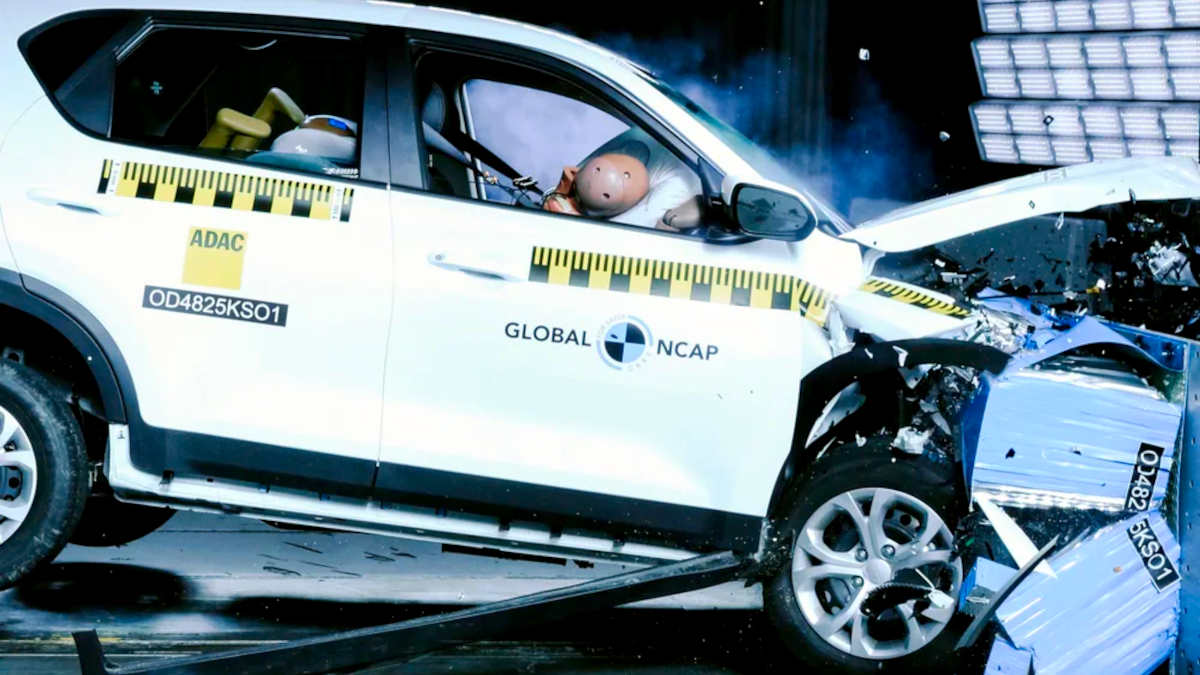
The safety conversation around compact SUVs has taken an unexpected turn with the latest crash test results. A newly published independent report has sent waves through the automotive community regarding one of the market's most popular sub-four-meter vehicles.
The India-built Kia Sonet has scored a disappointing 1-star safety rating in the latest round of Global NCAP crash tests. Conducted under the strict Safer Cars for Africa protocol, this sudden revelation has left prospective buyers wondering if their favorite compact SUV is genuinely safe.
However, before panic sets in among car enthusiasts, there is a massive catch to these alarming numbers. The tested vehicle represents a specific export variant that differs fundamentally from the model parked in local showrooms.
Key Features & Safety Pitfalls Exposed in the Test
The primary reason for the low score points directly toward the structural performance of the underlying platform during high-speed impacts. In the frontal offset crash evaluation, Global NCAP officially rated both the bodyshell and the footwell area as completely unstable.
The engineering analysis concluded that the vehicle’s cabin was simply not capable of withstanding further structural loadings. Furthermore, the absence of side curtain airbags as standard equipment meant that the critical side pole impact test could not even be attempted.
While head and neck protection for front passengers remained good, side impact tests revealed poor chest protection for the driver. This specific chest vulnerability severely dragged down the overall points allocation, anchoring the vehicle to its 1-star adult protection finish.
Specifications (Engine/Battery/Range & Crash Scores)
While the vehicle retains its standard mechanical engine and battery setups globally, the safety spec of this test unit was heavily stripped down. To fully understand why this rating occurred, we must look closely at the exact points allocation and variant configurations used.
- Adult Occupant Protection (AOP): Scored 21.29 out of 34 points, resulting in a 1-star rating due to weak chest protection.
- Child Occupant Protection (COP): Achieved 28.57 out of 49 points, securing a reasonable 3-star safety rating.
- Airbag Configuration: The tested African-spec model featured only dual front airbags instead of full side coverage.
- Electronic Stability Control (ESC): Completely missing from the standard base variant evaluated during this cycle.
- Child Restraint System (CRS): Earned full dynamic points for protecting both 18-month and 3-year-old rear-facing dummies.
The drop in child protection points came from the lack of a three-point seatbelt in the rear center position. Additionally, the tested model lacked a physical switch to disable the passenger-side front airbag when mounting a child seat.
Pricing and Market Launch Details
It is vital for Indian car buyers to recognize that Kia India radically altered its standard safety kit recently. While the entry-level export model is bare-bones, every single Kia Sonet sold in India comes equipped with six airbags and ESC as standard across all trims.
Because the domestic model features standard side and curtain airbags alongside Electronic Stability Control, this specific 1-star result does not apply to the Indian market. The domestic Sonet line starts at an competitive ex-showroom price of ₹7.34 Lakh, scaling up to ₹14.09 Lakh for the tech-loaded variants.
AkulRide Verdict: Is It a Game-Changer?
The Global NCAP crash test of the export-spec Kia Sonet serves as a massive wake-up call for global manufacturing standards. While the 1-star score sounds terrifying on paper, it highlights a frustrating double standard where export markets receive lesser safety gear than domestic buyers.
For Indian consumers, this news is actually a strong reassurance of why standardizing six airbags across the entire range was a masterstroke by Kia India. If you are buying a Sonet locally, you can drive with confidence knowing your car has the exact safety nets that this tested model severely lacked.
User Discussion