


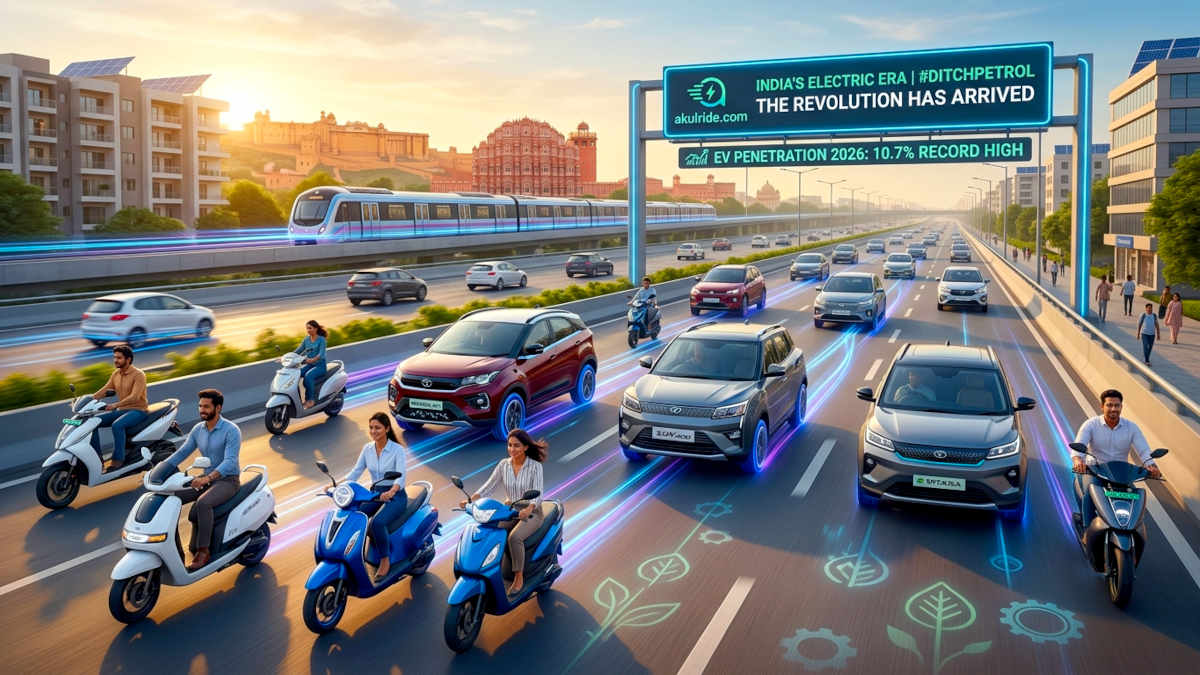
Step outside onto any major city street in India today, and you will notice an extraordinary transformation unfolding in real time. The familiar, deafening roar of internal combustion engines is rapidly fading, replaced by the smooth, futuristic hum of electric motors. What began as a cautious premium trend has officially exploded into a massive, consumer-led movement across the subcontinent.
The numbers don't lie: in May 2026, retail EV penetration in India shattered all previous records, crossing the historic double-digit milestone to hit an all-time high of 10.7%. Driven by skyrocketing petrol prices, enhanced battery safety benchmarks, and a flood of exciting new models, the country's grid is officially powering the future of transport. Whether you are navigating chaotic city traffic or plotting a weekend highway getaway, the electric era has officially arrived.
The Two-Wheeler Phenomenon: Driving India's Green Surge
While Western nations have focused almost entirely on electric cars, India's transition is uniquely driven on two wheels. Electric scooters and motorcycles have become the absolute spearhead of the domestic EV revolution, accounting for over 60% of all electric vehicle sales nationwide. For the average middle-class commuter, the economic argument has simply become too powerful to ignore.
Unpacking the Shocking Economics of E-Scooters
With petrol prices hovering past ₹100 per liter due to volatile global supply chains, fueling a traditional 110cc or 125cc commuter scooter feels like a constant financial drain. A petrol-powered two-wheeler now costs a painful ₹4 to ₹5 per kilometer to run on daily routes. In stark contrast, a modern electric scooter charging on a domestic connection costs a mere 25 to 40 paise per kilometer.
- The Daily Savings: An average 1,000-kilometer monthly city commute drops from nearly ₹4,500 in fuel down to less than ₹400 in electricity.
- The Legacy Shift: Traditional manufacturing giants like TVS with the iQube and Bajaj with the Chetak now command over 60% of the market, offering incredible build quality.
- The Subsidy Tailwind: Smart buyers are rushing to dealerships to leverage the PM E-DRIVE purchase incentives, which provide direct battery discounts up to July 31, 2026.
Mass-Market EV Cars: Breaking the Luxury Barrier
For years, electric cars were widely dismissed as expensive, impractical luxury toys reserved exclusively for multi-car households. However, the Indian passenger vehicle market has completely crossed that chasm in 2026. Electrification in the four-wheeler segment has reached an impressive 6.6% market penetration, transforming how families approach car ownership.
A Fierce Battle in the ₹12-25 Lakh Price Band
While Tata Motors continues to lead the electric car charge with its highly successful lineup, intense new competition has democratized the segment. Industry giants like Mahindra, JSW MG Motor, and even Maruti Suzuki—with its highly anticipated e Vitara launching earlier this year—are fighting aggressively for urban SUV buyers. This competitive explosion means better driving range, superior software features, and highly competitive pricing for consumers.
- Organic Market Demand: Unlike two-wheelers, electric passenger cars are thriving entirely on organic consumer demand without reliance on direct PM E-DRIVE purchase subsidies.
- Over-The-Air (OTA) Power: Modern Indian EVs are software-defined vehicles, receiving regular cloud updates that improve battery efficiency, navigation, and cabin tech overnight.
- Unmatched Tax Benefits: Buyers enjoy a heavily minimized 5% GST rate on electric cars, alongside massive savings on state road taxes and registration fees.
Infrastructure Expansion: Defeating Range Anxiety for Good
The single greatest psychological barrier preventing everyday motorists from going electric has always been the terrifying fear of getting stranded with a dead battery. Fortunately, India’s public charging infrastructure has expanded at a breakneck, exponential pace over the last 24 months. The country's public charging network successfully crossed 27,000 active stations, aggressively linking major cities and tier-2 hubs.
The Reality of Modern Green Corridors
Major national highways are rapidly transforming into highly reliable, interconnected green corridors. High-speed DC fast chargers are now standard features at popular highway food courts, traditional fuel stations, and star hotels. This robust network ensures that driving a mid-range electric SUV from Delhi to Jaipur or Mumbai to Pune is no longer an anxious gamble, but a completely routine, stress-free road trip.
- Rapid DC Topping: Modern highway charging stations can comfortably replenish an EV car battery from 10% to 80% capacity in less than 45 minutes.
- Unified Digital Access: Finding, reserving, and paying for a plug point is now managed seamlessly via unified smartphone apps.
- Residential Mandates: Modern apartment complexes and Resident Welfare Associations (RWAs) are actively installing dedicated charging zones to meet the surge in demand.
The Verdict: Is 2026 the Perfect Year to Make the Switch?
The explosive rise of electric vehicles across India is no longer a temporary experiment—it is the permanent blueprint of our national transportation ecosystem. If your typical weekly routine involves predictable urban commuting and you want to lock in ultra-low running costs for the next decade, investing in an EV is the single smartest upgrade you can make.
Take a close look at your daily driving distances, evaluate the charging accessibility in your immediate parking area, and head out to experience a comprehensive test drive. Step into the whisper-silent, high-torque world of modern electric mobility, and discover exactly why millions of Indian drivers are leaving the petrol pump behind for good.
User Discussion